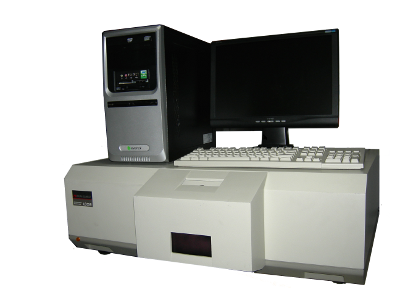
Sometimes I watch documentaries. I watched a WWII documentary that talked about tanks of this time period. My understanding is that the German Panzer Tank was a much better tank than the British Shermon tank. However, the British produced far more tanks than the Germans and it had a favorable outcome. The Perkin Elmer LS50B is kind of like the Shermon tank, while my favorite spectrofluorometer the Aminco Bowman Series II, is kind of like the German Panzer. I typically see 5-10X more LS50B fluorometers in auctions than AB2 fluorometers. Presumably there were many more of them sold. They are less expensive and they have a large assortment of accessories. When I sell these LS50B units, I usually buy used laptops. It cuts down the shipping costs. The laptop topic, is one area where the LS50B really beats the desktop-only AB2 . The AB2 must be run from a desktop computer as it depends on a PCI GPIB card but the LS50B is controlled form a serial port and a laptop will work fine. This cuts down on shipping costs for the initial shipment and it is also easier if you wish to order another used laptop after the two year warranty has expired. Included in the many accessories with the LS50B is a microplate reader attachment. The AB2 does not offer this. The microplate attachment is rather fussy and must be kept very clean in order to operate effectively but it is great for method development. I think that Thermo Electron still sells Aminco Bowman parts but I had read an article where it stated that they sold the rights for the AB2 to Horiba and discontinued the line in 2005. I do not know why they are still able to sell parts if Horiba owns the name now but the point is that the article stated that microplate fluorometers had been eating into the spectrofluorometer market and this was cited as the reason for the end of the product line. Microplate readers, whether spectrophotometry based or fluorometry based, have fantastic throughput but they are still just filter based instruments. A spectrofluorometer with a microplate attachment offers the features of continuously variable monochromators along with microplate technology and in my humble opinion, would be ideal for developing microplate reader methods for deployment on filter based instruments later. I would also like to mention that I quote with 2 year warranties with these spectrofluorometers but the new lamp has a 90 day limit. They are quite expensive and if they are left on all the time, they will expire in about 3 months. I doubt any of my customers would do this but I need to cover myself just incase. The LS50B is great but I feel that it has downsides too. The LS50B has a cheaper photomultiplier tube as standard. It can take an R928 tube to bring it up to the wavelength range of the AB2 but it is an option, not a standard feature. The signal to noise is not as good as well. It is physically larger. The top cover should be able to take quite a bit of weight but it is not explicitly specified as load bearing like the AB2. The sample compartment lid needs to partially overhang into the isle and opens downward. The lamp makes a buzzing sound and the software is usable but also rather horrible. Back in 2001 I found out that one company that sells HPLC equipment was using key disks. I learned that these key disks were specially formatted to make copying extremely difficult. These key disks would be deactivated during the installation process. This wonderful company(sarcasm intended)would charge the end user $2000 USD to reinstall the software they had already paid $12000 for. The law allows the end user to make a back up copy of their software yet this company's approach robbed the end user of this right. I decided to learn how to program and to free scientists from being treated like a nobleman's serfs. I now feel that I can write commercial quality software. With this background information, I would like to say that the software for the LS50B really bugs me. If someone is programing in what is referred to as a statically typed programming language, the code is typed into a text editor that is different but similar to what you might expect from a word processor and then this text based code is translated, or more specially, compiled into an executable file. The outputted file basically no longer contains human readable code and is basically just ones and zeros. If you write a 16 bit Windows application, it will run on a 32 bit Windows installation as there is a 16 bit sub-system to run these programs. However if you just recompile the code you already wrote on a 32 bit Windows version, the sub-system is not needed. I have no idea as to why Perkin Elmer does not do this but to my knowledge they are still only offering a 16 bit application to control the LS50B and even their current LS55. Windows 64 bit Professional versions are supposed to also have this 16 bit sub-system but it does not work with this software. If you want to run the LS50B software, you probably need to run Windows XP at the latest and you need to run it on a 32 bit computer. According to Perkin Elmer's website, the LS55 can run on Windows 7. I had trouble with Windows 7 but I was using a USB-Serial adapter. The software should be the same for the LS50B and the PE's current LS55 so I will retry with a fixed serial port card some time soon. Many things can be done with the software, it is certainly usable but it is frustrating that the software is so limited in terms of operating systems and the limits seem to be entirely self-inflicted, I cannot see any reason why the software could not be recompiled to run on a modern 64 bit computer architecture in 5 minutes or less. At the time of writing I am writing software to replace this problematic software. This website willlikely fall out date, please inquire as to whether or not I have completed the software if you are looking to control an LS50B. I also do not like the optics in the LS50B. The defractive grating pivots at the end of an arm rather then from it's center point. I do not know why this was done. There is a one time factory calibration that needs to be done with these fluorometers. A mercury lamp is positioned to shine into the unit and the calibration routine picks up on the emission lines from the lamp. This is not a calibration routine you would normally ever need to carry out as an end user but if a board fails, the calibration settings can be lost and the calibration routine can become a requirement. The routine is long, and annoying. Staff need to be very careful with the dangerous and fragile mercury lamp. I have an assembly I can send out but the utmost caution needs to be taken with it. I have never worked for PE and I do not know why the optics bench was designed to create a complex output that needs to be corrected. In contrast the AB2 is very easy to recalibrate. If you want to install a new monochromator in a given unit, the settings for that monochromator are written right on it and there are simple rotary dials on the CPU board that can be turned to harmonize the settings of the circuit boards to the actual monochromator. No mercury lamp is required and if the settings written on the monochromator no longer match, there is a simple procedure using a fluorescent lamp and powered milk to re-calibrate and there is even a short cut to even avoid this simple procedure if you don' t want to buy powder milk. The beam in the LS50B is also much larger than the AB2 and it is vertical so the cuvette must be mostly filled. I have also been told that the Varian Eclipse also has a very large beam as well. Beam sizes are not normally specified but this could be very critical if you are working with high value, low volume liquids. I would also like to mention that there are "nano-drop" units on the market now that are being used for spectrophotometry and spectrofluometry and that they can work with very small sample sizes. However, I would also like to say that their performances as spectrophotometers and spectrofluorometers are a joke and they are in no other way competitive.